Victim protection must be built into enforcement operations from the start
Freedom Collaborative contributes survivor-centered recommendations to a UNODC dialogue, the Council of Europe’s anti-trafficking body meets to assess member states, and reports examine exploitation in China’s solar panel sector.
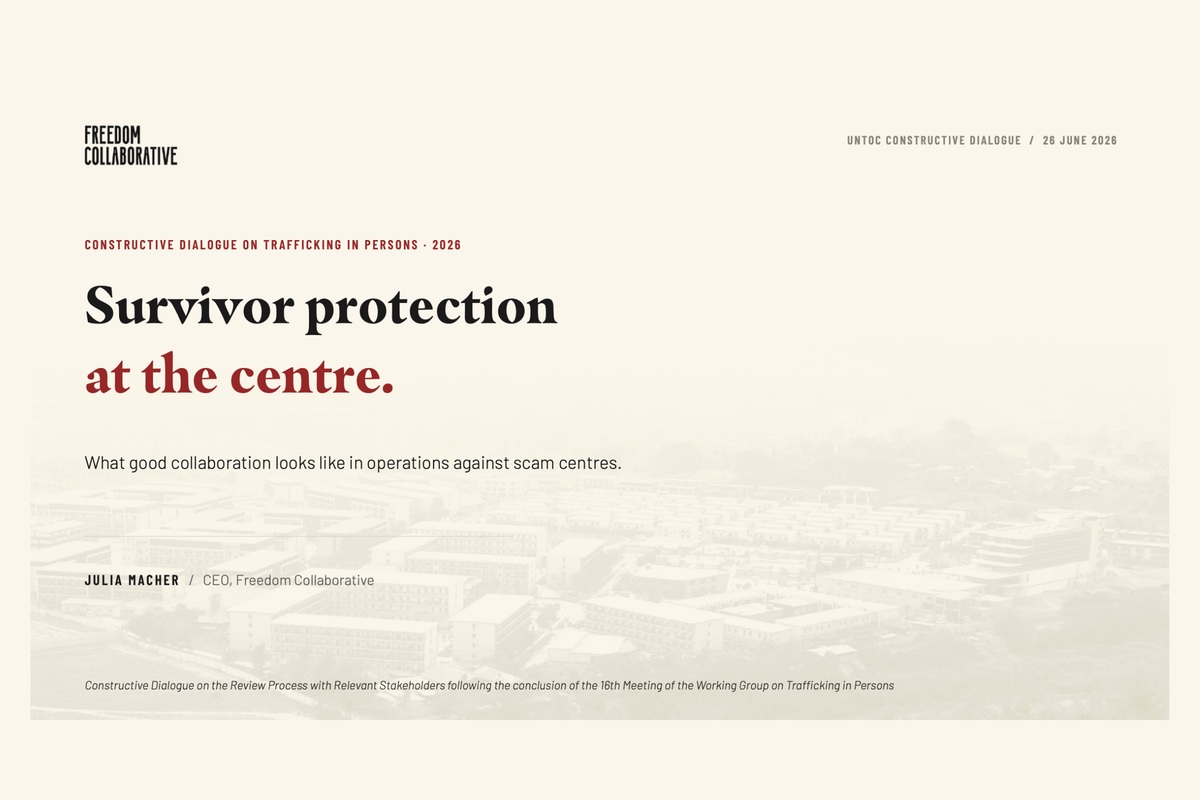
Freedom Collaborative’s CEO, Julia Macher, contributed to the fifth Constructive Dialogue on Trafficking in Persons last week, highlighting the importance of placing survivor protection at the center of operations against scam compounds.
The ongoing protection crisis affecting people exiting scam operations is not the result of a lack of knowledge, she noted, but stems from failures of implementation, accountability, and ownership. While governments and other authorities increasingly recognize the scale and seriousness of the issue, protection responsibilities are still too often addressed late, inconsistently, or without sufficient coordination and resources.
Awareness of scam compound trafficking is greater than ever, with growing research, reporting, survivor testimony, and operational experience pointing in the same direction. Tools such as our new Data Spotlight can help make emerging patterns more visible. But while the sector already has a clear understanding of what good collaboration looks like, responsibility, resources, and action must follow that insight.
Against this backdrop, we outlined three observations and explored what meaningful collaboration would look like if survivor protection were built into operations from the outset.
First, victim identification should not depend on which authority encounters a person first. While policy discussions often refer broadly to “victims” or “survivors”, in reality these categories encompass a wide range of experiences, including formally identified trafficking victims, people exiting scam compounds, people in detention or transit, and those who never enter formal protection systems at all. As a result, the same individual may be treated as a trafficking victim, an immigration violator, or a criminal suspect, depending solely on who first comes into contact with them. Instead, authorities and operational partners should agree in advance on screening, identification, referral, non-punishment, and immediate protection procedures for people exiting scam compounds, rather than leaving these decisions to be made on an ad-hoc basis.
Moreover, civil society should be viewed as part of the operational architecture rather than an emergency backstop. Across the region, frontline organizations continue to shoulder a disproportionate share of responsibility for victim identification, emergency assistance, case management, repatriation, evidence gathering, and advocacy. While their contribution has been indispensable, it has also allowed systemic gaps elsewhere in the response to persist. Civil society’s resilience should not be mistaken for capacity within formal protection systems, but frontline organizations should be involved before, during, and after operations, with clearly defined roles, safe information-sharing channels, and reliable resources.
Finally, survivor protection and law enforcement objectives should be understood as mutually reinforcing. Survivors often possess valuable information about recruitment pathways, movement patterns, scam compound operations, and the criminal networks behind them. That information is far less likely to be shared when individuals are treated primarily as offenders rather than potential victims. The success of an operation should be assessed not only by arrests or compound closures, but also by whether survivors are identified, protected from punishment, connected to services, and able to access safe onward options.
Taken together, these observations point towards a more coordinated approach in which protection is built into operations from the beginning. This would involve law enforcement agencies, immigration authorities, victim protection actors, embassies, and civil society organizations planning together before action is taken; agreeing referral and screening pathways in advance; ensuring that survivor support is properly resourced; and treating people leaving scam compounds as potential victims requiring assessment and protection rather than offenders by default.
The fifth Constructive Dialogue on Trafficking in Persons was convened as part of the review process for implementation of the United Nations Convention against Transnational Organized Crime and its Protocols. Bringing together governments, civil society, academia, and private-sector stakeholders, the Dialogue provides an opportunity for non-governmental actors to exchange perspectives on emerging trafficking trends, strengthen collaboration in the global response, and inform discussions on better implementation of international anti-trafficking commitments. This year’s meeting focused in particular on combating trafficking in persons in relation to scam centers, and the use of artificial intelligence in trafficking in persons and related challenges in response.
We are grateful to the UNODC Civil Society Unit for convening the dialogue, to the Freedom Fund for nominating us as a peer organization to contribute to the discussion, and to our Forced Criminality Response Working Group, whose insights informed our observations.
Here’s a roundup of other noteworthy news and initiatives:
The U.S. Treasury has sanctioned nine individuals and 26 entities linked to the Prince Group transnational criminal organization, as part of wider efforts to disrupt Southeast Asia-based scam operations targeting U.S. victims. The action is aimed at alleged leadership, investors, front companies, and financial infrastructure connected to cyber-enabled fraud, money laundering, and scam compounds, where recruited workers are reportedly subjected to passport confiscation, debt bondage, violence, and coercion to carry out online scams.
Globalworks has published two new reports on labour conditions across China’s solar panel sector, documenting both state-imposed forced labour risks and factory-level exploitation. The first report examines how poverty-alleviation programs, resettlement schemes, and land transfers channel poor households and ethnic-minority communities into state-led labour mobilization, while the second draws on worker social media testimonies to highlight excessive overtime, withheld wages, deceptive recruitment, unsafe working environments, and inadequate dormitory accommodation across solar panel factories.
GRETA held its 57th plenary meeting in Strasbourg last week, adopting final trafficking evaluation reports on Belgium, Luxembourg, and Belarus, and approving draft reports on Ireland, North Macedonia, Serbia, and Slovenia. The Council of Europe's anti-trafficking body also adopted new guidance on residence permits for victims of trafficking, and held an exchange with members of the European Committee of Social Rights.
The new special issue of the RUSI Journal examines how organized crime is evolving amid fragmented geopolitics, disruptive technologies, and hybrid threats. Bringing together researchers and practitioners, the issue explores themes including crime in the digital age; crime, statecraft and geopolitics; and criminal governance, democracy, and control, while highlighting how organized crime has become more adaptive, technologically enabled, and politically entwined.
This blog article examines forced labour remediation in Taiwan’s bicycle industry, following investigations into recruitment-fee debt bondage and exploitation affecting migrant workers. It highlights progress including worker reimbursements, no-fee recruitment policies, and an industry-wide human rights initiative, while warning that implementation remains uneven, particularly in lower tiers of the supply chain where oversight is weakest.
Catholic anti-trafficking leaders from 23 countries have gathered in Thailand for the 6th International Talitha Kum Leadership Training Course, aimed at strengthening grassroots responses to human trafficking and modern exploitation. The program focuses on prevention, survivor protection, leadership, and international cooperation, with participants also examining the role of digital technology in trafficking and highlighting Thailand’s education-based anti-trafficking model as a potential approach for wider replication.
A 2026 UN High-Level Political Forum side event on 13 July will examine community-led approaches to combating human trafficking in Liberia and Sierra Leone. The in-person event in New York will explore the ways in which evidence-based partnerships can improve victim identification, strengthen access to protection, and support safer, more resilient communities.