Global attention on cyber-scam trafficking is not reflected in survivor support
Experts at GI-TOC’s recent conference highlight the challenges faced by those leaving cyber-scam centers, advocates call for the U.S. to restore protections for victims of trafficking, and a new report warns of risks to the global asylum system.

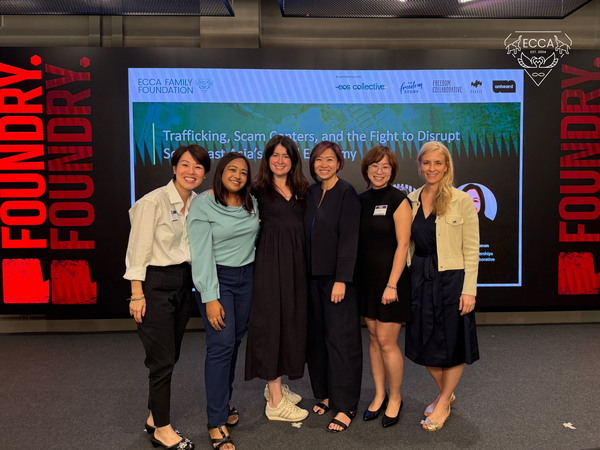
Last week, the Global Initiative Against Transnational Organized Crime (GI-TOC) hosted its annual 24-hour conference, bringing together practitioners, researchers, and frontline groups working on complex organized crime challenges worldwide. Freedom Collaborative participated in two sessions – one panel examining emerging evidence on trafficking for forced criminality inside online scam operations, and another featuring survivors sharing their experiences. Together, these discussions highlighted a persistent gap between the rising global attention on cyber-scam trafficking and the limited support available to the individuals who manage to leave these operations.
In the first session, Freedom Collaborative joined long-time colleagues and partners with whom we’ve been working to better understand and respond to the growth of forced online scamming across Southeast Asia and other areas. The panel underscored the extent to which the issue has evolved and the significant impact it now has on communities far beyond the region. Speakers emphasized that meaningful progress requires sustained cross-border and cross-sector collaboration, and that shared platforms for coordination and intelligence exchange are increasingly important.
Frontline insights from the Thai–Myanmar border illustrated the scale of the challenge. More than 7,000 individuals have been screened this year after leaving scam compounds in Myawaddy, representing up to 77 nationalities. Screening teams often process 60 to 400 people per day, severely limiting the time available for in-depth interviews or tailored assessments. Civil society organizations carry much of the operational load – providing interpreters, covering basic needs, and raising funds for repatriation flights when governments are unable to support their nationals.
Speakers noted that individuals arriving at the border frequently have overlapping experiences of deception, coercion, and forced involvement in illicit activities. Some were lured by false job offers; others were compelled to commit online fraud under threat; and some were pressured into roles involving oversight or recruitment. These varied trajectories challenge the traditional “victim” versus “perpetrator” framework, and current identification systems, especially under high-volume, time-limited conditions, struggle to reflect this complexity.
This misalignment has practical consequences, the speakers noted. Many individuals prioritize returning home as quickly as possible rather than entering legal processes that could prolong their stay in shelters. Yet this does not always resolve their vulnerabilities – practitioners highlighted cases in which survivors face limited assistance, inconsistent follow-up, or even legal repercussions upon arrival. Moreover, the risk of re-trafficking remains high. Several survivors shared that, in situations in which social, economic, or family pressures are severe, the sense of safety after escape can be fragile, and the decision-making space for avoiding re-exploitation extremely limited.
In response to a question from an audience member on whether NGOs are becoming fatigued by fundraising for people who do not fit neatly into established victim categories, CSOs acknowledged the strain but noted that humanitarian needs cannot be determined solely through rigid classifications. The realities of forced criminality require flexible and context-sensitive responses, and people in ambiguous situations often face the greatest barriers to protection, they said.
The survivor panel further reinforced the need for holistic support systems – participants described long, uncertain periods in temporary camps inside Myanmar controlled by armed actors, the stress of navigating the screening process, and the challenges of returning home to environments that may not provide stability or safety. Their testimonies illustrated that recovery is shaped not only by what occurred inside the compounds but also by the circumstances to which they return.
Across both sessions, a clear message emerged: awareness of trafficking for forced criminality is growing, but the human impact continues to receive insufficient attention. Enforcement actions and policy discussions are advancing at the regional level, yet the systems people encounter once they escape have not adapted to the scale, diversity, or nature of this form of exploitation.
As Freedom Collaborative and our partners emphasized throughout the conference, addressing these gaps will require improved identification processes, stronger cross-border coordination, and more reliable post-return pathways that recognize the complexities of survivors’ experiences and the risks they face. Without these efforts, individuals leaving cyber-scam compounds will continue to carry the greatest burden of a transnational crime challenge that remains significantly ahead of the systems designed to respond to it.
Here’s a roundup of other noteworthy news and initiatives:
ATEST has urged the United States Congress to reauthorize the lapsed provisions of the Trafficking Victims Protection Act (TVPA), warning that critical services, survivor support, and U.S. anti-trafficking leadership are at risk without immediate action. Recent commentary underscores that cuts to the State Department’s anti-trafficking office further threaten 25 years of progress, making robust reauthorization and renewed federal commitment essential for protecting victims and sustaining the TVPA’s global impact.
Also in the U.S., Polaris has announced it has fully transferred all National Human Trafficking Hotline operations to Compass Connections, ending its operational role after nearly 20 years. The organization will now focus on new initiatives that strengthen coordination, expand data and intelligence efforts, and elevate survivor- and community-driven solutions.
The recently published Mixed Migration Review 2025 warns that escalating geopolitical turmoil and increasingly extreme migration policies, driven in part by renewed U.S. hardline measures, are pushing the global asylum system towards breaking point. Yet it also highlights growing forms of resistance, showing that legal challenges, community solidarity, and inclusive national policies can still shift the trajectory towards a more humane and rights-based approach.
EU institutions are set to finalize a revised Victims’ Rights Directive that will significantly expand protection, support, and access to justice for victims of trafficking and other violations, including the most vulnerable. According to La Strada International, the proposal strengthens reporting mechanisms, specialized services, safety measures, and access to compensation across the EU.
IOM has launched Anyone a Victim, a global campaign calling for stronger action to prevent human trafficking and expand long-term support for survivors, while elevating survivor voices and challenging misconceptions about who is at risk. The campaign represents a significant push towards rights-based, community-driven, and prevention-focused strategies that aim to strengthen partnerships, mobilize public engagement, and expand resources for survivor-centered work.
The new publication Evaluating Anti-Trafficking Interventions underscores the lack of evidence on the effectiveness of current anti-trafficking efforts despite significant global spending. By combining practical evaluation tools, theoretical foundations, and insights from diverse case studies, the book equips professionals with clearer approaches for assessing what works, what doesn’t, and how interventions can be improved.
This article argues that Trump’s new tariffs will not protect U.S. workers, but instead reinforce corporate power and deepen exploitation across Nike’s global supply chain, where workers already face poverty wages, layoffs, and worsening conditions. It highlights growing cross-border labour solidarity, from garment workers in Asia to unions in Oregon, as the real pathway to challenging corporate greed and building a fairer global economy.