Former TIP Office leaders urge focus on core values and bipartisan alliances
U.S. anti-trafficking experts call on stakeholders to maintain coalitions amid federal cutbacks, Cambodian scam compound workers are hiding in rural areas for fear of arrest, and forced labour import bans must be backed by structural reform.
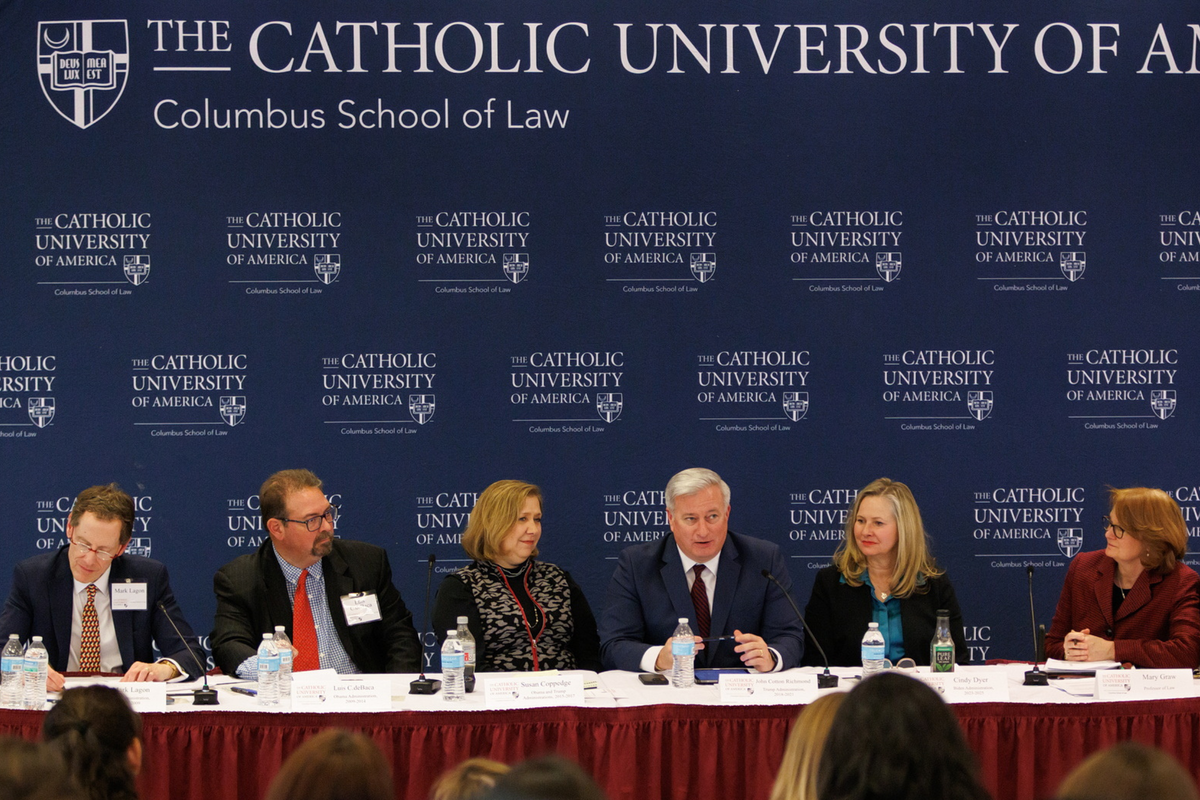
The five most recent Ambassadors-at-Large of the U.S. Office to Monitor and Combat Trafficking in Persons (TIP Office) have called on partners to preserve the bipartisan multi-stakeholder coalition that has driven much of the movement’s progress over the past 25 years, amid sweeping policy and institutional changes by the current administration. Brought together by The Catholic University of America Columbus School of Law to mark the 25th Anniversary of the Trafficking Victims Protection Act (TVPA), Mark Lagon, Luis C.deBaca, Susan Coppedge, John Cotton Richmond, and Cindy Dyer also urged continued focus on sustaining and building upon the core achievements of the Office, including the 3Ps framework of prevention, protection, and prosecution, the elevation of survivor empowerment, and legislation that upholds the non-punishment principle.
Established in 2000 and led by an Ambassador-at-Large, the TIP Office became a central driver of global anti-trafficking efforts, combining diplomatic influence, interagency coordination, and a high-profile platform that sustained political attention and resources. Over 25 years, it helped build rare bipartisan consensus and broadened the field’s focus beyond prosecution to include prevention and survivor protection, advanced survivor leadership and the non-punishment principle, and expanded its scope from a primary focus on sex trafficking to include a stronger emphasis on labour trafficking.
However, the current administration has reversed course on many of these efforts – it has cut the TIP Office by more than 70 per cent, merged it into a larger bureau, failed to name an ambassador, and terminated 69 international programs aimed at combating child labour, forced labour and human trafficking. Furthermore, the reductions, alongside cuts to specialized staff and resources at investigative agencies and the departments of State, Labor and Justice, have weakened enforcement, prosecutions, and survivor support. At the same time, the diversion of federal law-enforcement personnel towards immigration enforcement has sharply reduced trafficking investigations, while conflating migration control with anti-trafficking work risks undermining legal protections for undocumented victims.
Internationally, the downgrading of the TIP Office and the ambassadorial rank has reduced U.S. diplomatic leverage, limiting the ability to press foreign governments for reforms and weakening the hand of civil society organizations (CSOs) that rely on U.S. pressure and the credibility of the annual TIP Report. Speakers linked declining U.S. influence to troubling global trends: falling prosecutions and convictions, extremely low victim identification compared with estimated prevalence, and rising trafficker profits. They also highlighted faltering implementation of forced-labour import bans, warning that strong legislation without consistent resourcing and political backing creates a permissive environment for exploitation.
Despite the sobering assessment, the ambassadors voiced cautious optimism about the road ahead. They pointed to the enduring bipartisan nature of anti-trafficking work – and the unusually broad coalitions the movement has long been able to convene – as a source of resilience. Even now, they said, there are signs of cross-party cooperation on issues such as transnational online scam operations and other forms of organized exploitation, suggesting that common ground still exists.
Panelists underscored civil society as a stabilizing force at a moment of institutional retrenchment, describing NGOs as essential to preserving hard-won gains and sustaining momentum. Beyond advocacy, CSOs serve as frontline implementers — delivering survivor services, supporting victim identification, partnering with law enforcement, and engaging the private sector — while also acting as independent voices able to press governments to uphold their commitments. By maintaining cross-sector alliances and centering survivor leadership, civil society can help prevent backsliding and keep critical networks intact during a period of reduced government capacity, they noted.
The ambassadors stressed that the path forward does not require new frameworks so much as renewed commitment to implementing the ones already in place. They called for practical partnership with policymakers — offering clear plans, technical expertise, and evidence-based strategies to help translate shared concerns into concrete action. Immediate priorities include restoring funding, re-establishing independent leadership, strengthening enforcement capacity, and refocusing on the core pillars of prevention, protection, and prosecution. With sustained civic engagement and determined cross-sector collaboration, they argued, the United States can still reclaim a leadership role in the global fight against modern slavery.
Here’s a roundup of other noteworthy news and initiatives:
Following weeks of compound clear-outs across Cambodia, new reporting from Koh Kong shows displaced foreign workers, many likely trafficked, scattering into rural areas, hiding in farms and forests, and avoiding transport due to checkpoints and fear of arrest. Some compounds have only partially emptied and remain active, underscoring concerns that enforcement is displacing victims without screening or protection and may relocate exploitation rather than dismantle networks.
Marking the World Day of Prayer and Awareness against Human Trafficking, Pope Leo XIV condemned trafficking as a “crime against humanity”, highlighting growing “cyber slavery” in which victims are coerced into online fraud and criminal activities. He linked trafficking to conflict, instability, and exploitation of people on the move, especially women and children, while urging greater awareness, dignity-centered responses, and continued support for survivors.
A new ILO research brief finds import bans on goods produced with forced labour can contribute to remediation and incentivize change, particularly when paired with social dialogue and engagement by companies and local stakeholders. However, the analysis stresses bans alone cannot address root causes, warning that without complementary labour regulation and structural reforms, forced labour risks are likely to persist across supply chains.
Human rights groups warn that a reported U.S. State Department directive limiting use of sources linked to LGBTQI+, racial justice, and DEI advocacy in its annual Human Rights Reports would undermine a key global accountability tool. Advocates say excluding civil society documentation risks obscuring abuses, weakening evidence used for policy and funding decisions, and reducing protections for vulnerable populations worldwide.
In Ireland, a collapsed security firm is facing multiple cases after allegedly systematically recruiting migrant workers from Africa and Asia and failing to pay wages, with unions likening the pattern of exploitation and targeting to “modern slavery”. The case highlights how labour violations, racial discrimination, and insolvency loopholes can leave migrant workers without remedies or compensation even after successful rulings.
This opinion piece argues social media platforms function as marketplaces for child sexual exploitation and trafficking, enabled by U.S. Section 230 liability protections that shield companies even when harms are foreseeable or reported. The author calls for the law to be repealed to enable civil accountability and incentivize stronger safety measures, framing legal reform as necessary to prevent large-scale online exploitation.
The newly launched Lighthouse Global Protection Fund will provide rapid, flexible protection support to at-risk human rights defenders and civil society organizations through a consortium of regional partners. Backed by multiple governments and foundations, the pooled funding mechanism aims to channel more resources directly to defenders and strengthen global protection capacity.