A new data approach aims to make forced labour more visible
The WEF’s new report shows how networked data can strengthen action against forced labour, CSOs call for urgent support for survivors fleeing Cambodia’s scam compounds, and the U.S. State Department requests information for its TIP Report.
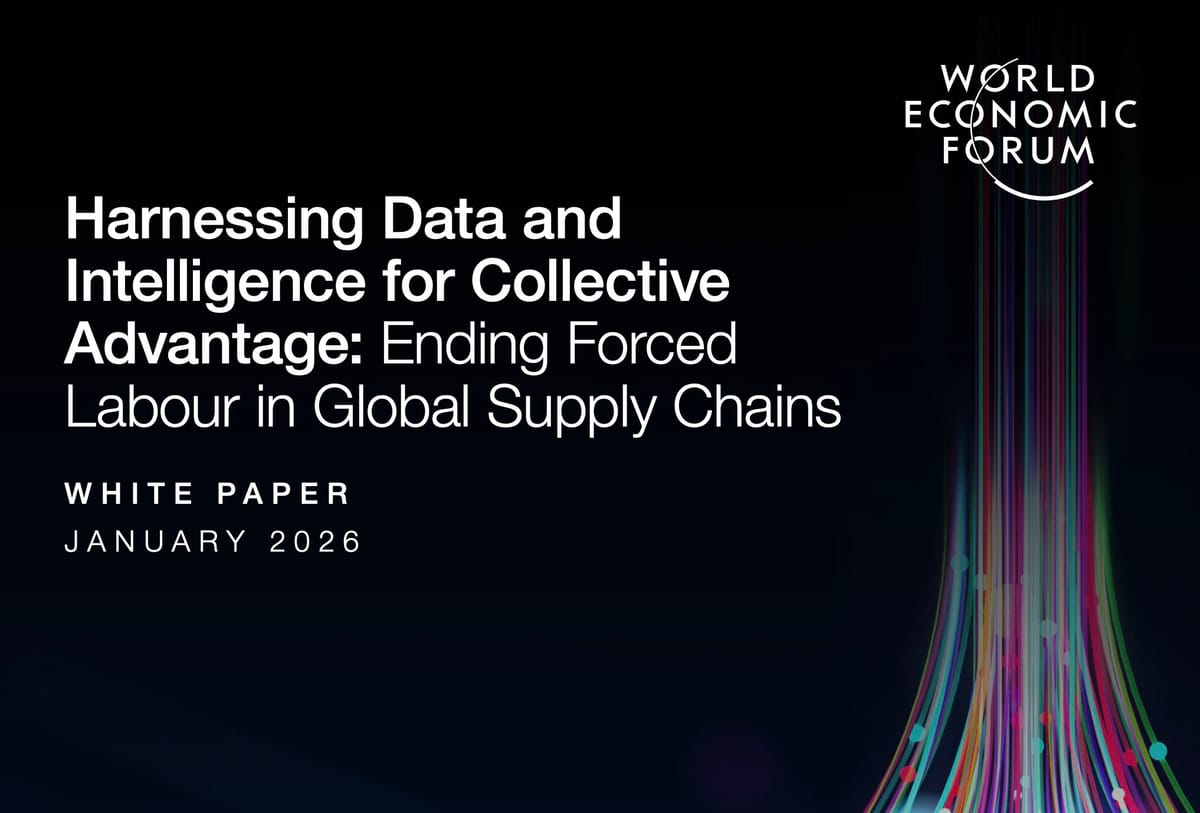
A white paper launched today by the World Economic Forum highlights how federated shared intelligence can transform efforts to prevent forced labour by strengthening visibility across governments, businesses and civil society. Launched at the Forum’s Annual Meeting in Davos, Switzerland, the report, Harnessing Data and Intelligence for Collective Advantage: Ending Forced Labour in Global Supply Chains, sets out how a networked, permission-based structure supported by AI and built on trusted, verified data sources can make data federation possible, impactful and scalable. It is hoped this new model of collaboration will be used to identify forced labour risks hidden in plain sight and create new ways to tackle them collectively.
The white paper draws on findings from the Global Data Partnership Against Forced Labour, a multi-stakeholder initiative of which Freedom Collaborative is a member. Comprising international organizations, private companies and civil society organizations (CSOs), the group works towards the elimination of supply-chain-related forced labour and seeks to drive systemic change by transforming how data is shared and used, enabling stakeholders to take more effective, evidence-based and accountable action.
The partnership was established in response to a persistent challenge: while governments, businesses, civil society and worker groups each hold essential insights, no single actor has full visibility. Data remains siloed, incentives are often misaligned, and trust is limited. This fragmentation weakens accountability, prevents coordinated action, and causes progress to stall — reinforcing the very conditions that allow forced labour to persist.
To address this, the partnership is developing pre-competitive infrastructure designed to strengthen collective visibility. Built on a federated model supported by AI, it links existing systems through shared standards and governance protocols, allowing participants – including governments, businesses, civil society and worker-based organizations – to generate collective intelligence while retaining control of their own data, safeguarding confidentiality, and protecting affected communities. By drawing reliable insights from multiple stakeholders, the system can reveal early patterns of exploitation and enable faster, more targeted action, while ensuring that worker and survivor data is used for prevention, remedy and accountability, instead of punishment or profit.
The report describes four interconnected frameworks that underpin the partnership’s work. The first focuses on data standards – including shared inclusion and quality criteria – and alignment with International Labour Organization standards. A second framework centres on governance and safeguarding, covering privacy, consent and competition protections, alongside formal channels for worker and civil society voices. The third addresses stakeholder value creation and resourcing, mapping incentives that sustain participation and developing metrics for collective advantage and social return. Finally, a policy and action framework is designed to ensure insights translate into practice, connecting analytics to real-world interventions and linking evidence to prevention and remedy. Early work in Thailand illustrates how this approach can surface emerging risks, strengthen prevention efforts, and support more coordinated action, while also demonstrating the technical and institutional feasibility of safe cross-dataset analysis.
Scalable by design, the federated architecture can expand across sectors, regions and institutions without centralizing authority or compromising sovereignty, the report notes. As participation grows, each new dataset enhances analytical power, stronger insights increase incentives to collaborate, and broader engagement accelerates prevention, thus creating a virtuous cycle of shared intelligence and collaborative action. Over time, the aim is to deliver shared, near-real-time intelligence that guides decision-making and tracks progress, with the ultimate goal of informing public understanding of the systemic nature of forced labour and helping fuel a broader movement toward its eradication.
The partnership now sees a critical opportunity to expand participation and scale insights globally in support of efforts to end forced labour by 2030, and hopes more stakeholders will join as it advances towards its 2026 development phase, the report says. “By connecting insights securely, applying shared intelligence, and demonstrating measurable progress, forced labour can become a preventable risk rather than an enduring reality.”
Here’s a roundup of other noteworthy news and initiatives:
Ioana Bauer, President of eLiberare, has been named the first Romanian Schwab Foundation Award winner, and will be formally recognized at a ceremony during the World Economic Forum’s Annual Meeting in Davos. The award, presented in partnership with the Forum, recognizes Bauer’s contribution to the development and scaling of systemic approaches to preventing and combating human trafficking and sexual exploitation.
Civil society organizations are reporting being overwhelmed as large numbers of people flee Cambodia’s cyber-scam compounds following the arrest of alleged scam mastermind Chen Zhi. Many survivors face re-detention, re-exploitation or homelessness, prompting CSOs to call on international organizations, UN agencies, donors and diplomatic missions to provide urgent protection, shelter, documentation support and safe repatriation pathways.
A new two-part policy brief series from the Global Initiative Against Transnational Organized Crime examines how private-sector actors may be exposed to cyber-scam operations through legitimate commercial activity, while offering practical guidance for companies seeking to avoid buying from, selling to, or partnering with entities linked to scam compounds. While earlier research has focused on criminal networks, financial architecture and digital infrastructure, the series shifts attention to the industries, suppliers and service providers that interact directly with scam operations.
Oman has enacted a new anti-trafficking law that expands key legal definitions, strengthens protections for victims, and imposes harsher penalties on perpetrators. While the legislation introduces important safeguards, observers note that its impact may be limited by the continued operation of the Kafala system, the absence of a dedicated compensation mechanism for victims, and a government approach that remains narrowly focused on sex trafficking.
The World Benchmarking Alliance has released its latest Corporate Human Rights Benchmark, showing that, while some progress has been made, one in four companies assessed has regressed on human rights performance and only one in ten evaluates how human rights impacts relate to its business model. The benchmark provides a comparative snapshot of leading companies in high-risk sectors, assessing the policies, processes and practices they have in place to systematise their approach to human rights.
The UNODC has launched a new publication examining the role public officials may play in facilitating human trafficking and the sectors most vulnerable to this phenomenon. The study focuses on the intersection of corruption and trafficking, illustrating how corruption enables exploitation at every stage of the trafficking process, while profits generated through trafficking fuel further corruption.
The U.S. State Department has issued a request for information from CSOs for inclusion in the 2026 TIP Report, seeking inputs on emerging trafficking trends as well as examples of government successes and challenges in prosecution, victim identification and protection, and prevention efforts. The Department has also indicated particular interest in examples of innovation, technology and ground-breaking anti-trafficking practices that have delivered measurable impact at the community level or influenced broader anti-trafficking responses. Submissions are due by 27 February.
Walk Free is inviting organizations to complete its Government Response Survey, which gathers inputs on how effectively governments are responding to modern slavery. The survey plays a central role in Walk Free’s efforts to assess government action and inaction across key indicators, and will inform the government response assessment for the 2027 Global Slavery Index.